The Rings of Suffering: A Refined, Clinical Approach to Lasting Change
Christine Partamian, LPC
If you are considering private counseling, you may be seeking something deeper than short-term relief—something more precise, more sustainable, and more aligned with who you are.
In my work with clients navigating anxiety, body dysmorphia, life transitions, and relationship challenges, I often begin with a foundational framework from Acceptance and Commitment Therapy (ACT) known as the “rings of suffering.”
This concept offers both clarity and relief, helping you understand not only what you feel—but why it may feel so persistent.
A Visual Introduction
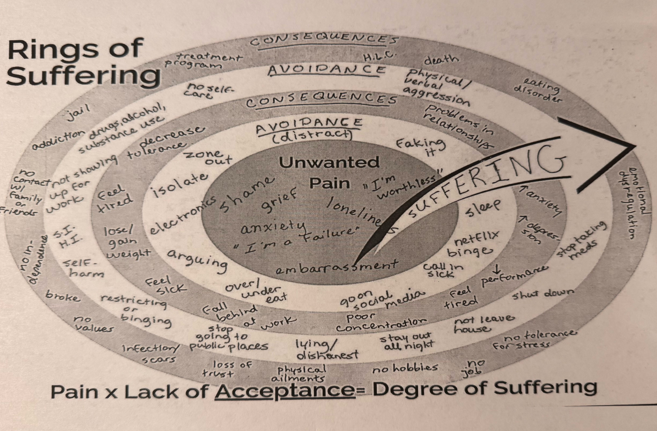
At its core, this model distinguishes between two layers of experience:
- The Inner Circle → Primary Suffering
- The Outer Rings → Secondary Suffering Caused by Avoidance and the Resulting Consequences
Primary Suffering: The Cost of a Meaningful Life
Primary suffering is the inevitable emotional experience that accompanies living with depth and awareness.
This may include:
- Anxiety when facing uncertainty or high expectations
- Distress related to body image or self-perception
- Emotional discomfort during life transitions
- Vulnerability, conflict, or longing within relationships
From a clinical perspective, these responses are not dysfunction—they are intelligent signals that reflect what matters to you.
Secondary Suffering: Where Distress Becomes
Entrenched
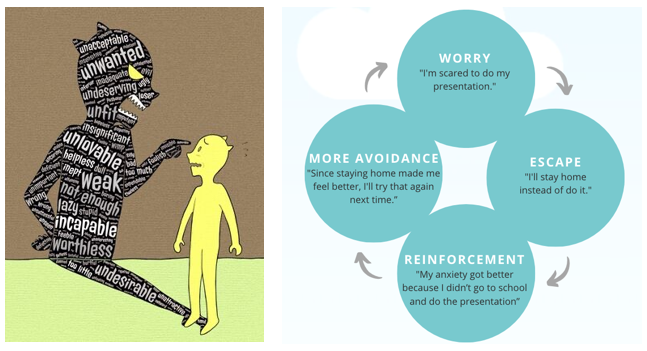
Secondary suffering develops in how we respond to those initial experiences.
This often includes:
- Self-criticism and internal judgment
- Fixation on perceived flaws (particularly in body dysmorphia)
- Avoidance of situations that evoke discomfort
- Overanalysis, rumination, or emotional suppression
It is this outer ring that often keeps clients feeling stuck.
The Therapeutic Focus: Precision Over Suppression
ACT is designed to reduce this secondary layer of suffering—not by eliminating emotion, but by transforming your relationship to it.
In our work together, we focus on:
- Awareness without over-identification
- Cognitive flexibility, especially with self-critical thoughts
- Emotional tolerance, without escalation or avoidance
- Values-based action, particularly in relationships and life direction
This is a structured, skill-based process that restores a sense of clarity and control.
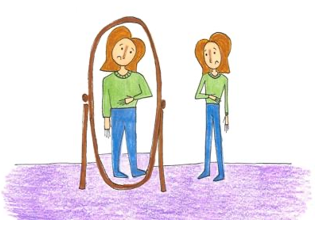
Applied Example: Anxiety & Self-Perception
- Primary suffering:
“I feel anxious being seen.”
“I feel distressed about my appearance.” - Secondary suffering:
“I shouldn’t feel this way.”
“I need to fix this or avoid it.”
In therapy, we work to reduce the second layer—allowing you to move through life with greater ease, even when discomfort is present.
A More Refined Experience of Therapy
Clients who seek out my work are often looking for a thoughtful, elevated therapeutic experience—one that is both clinically grounded and personally attuned.
This process is:
- Structured and evidence-based
- Tailored to your individual experience
- Focused on meaningful, lasting change
You are not asked to ignore your emotions—but to relate to them in a way that is more skillful, more measured, and ultimately more freeing.
Why This Work Matters
Whether you are navigating:
- Persistent anxiety
- Body dysmorphia or appearance-related distress
- A significant life transition
- Complex or unfulfilling relationships
…the goal is not to eliminate discomfort entirely.
The goal is to ensure that it no longer defines your decisions or limits your life.
A Final Thought
Many clients begin with the quiet belief:
“I shouldn’t feel this way.”
A more useful perspective is this:
Your initial experience may be unavoidable….
But the additional suffering layered on top of it is absolutely something we can change—together.

Christine Partamian, LPC
Doors of Hope Counseling
📧 Email: christine.doorsofhope@gmail.com
📞 Phone: 913-600-5690
🌐 Website: https://www.doorsofhopekc.com